
Washtenaw City Directory Collections
AADL has the central local collection: Ann Arbor city directories from 1868 through 2001 are available for online search and browsing, while print copies and related collections include Ann Arbor, Ypsilanti, and county material. The Library of Michigan’s Washtenaw guide adds selected county directories, land atlases, newspapers, census resources, and older county sources. Gaps are meaningful. Do not infer that every intervening year was printed or survives simply because nearby editions are present.
| Collection | Years | Where Held | Access |
|---|---|---|---|
| Ann Arbor city directories | 1868-2001, with item gaps | AADL Archives and Downtown print holdings | Online search/browse, print, and staff help |
| County and city editions | 1883-84, 1886-89, and later selected runs | AADL and Library of Michigan | Collection and guide research |
| Polk and related directories | 1908, 1910, 1912-79 and later selected years | AADL and Library of Michigan | Online or in-library, depending on volume |
| Ann Arbor-Washtenaw and late Ann Arbor runs | 1996-98 and 2000-01 | AADL | Item-level browse route |
Named editions include Chapin’s 1868 directory, Cole & Keating’s 1872 volume, county-wide volumes in the 1880s, Glen V. Mills editions in the 1890s and early 1900s, and long Polk runs. The last listed Ann Arbor run is 2000-01.
AADL Washtenaw City Directory Access
AADL Archives offers online searching and browsing for the digitized directory run. The archive research interface has a format selector, year limiter, publication-year sorting, list and grid views, and Apply and Reset controls. The Downtown branch’s third-floor Local History area holds directories, periodicals, yearbooks, maps, atlases, newspapers, Sanborn microfilm, and Washtenaw census microfilm. The physical archive is staff-assisted, so contact the library when an item is not online.
AADL’s archive and directory route is shown below. Save the item year and page or item reference with every result.
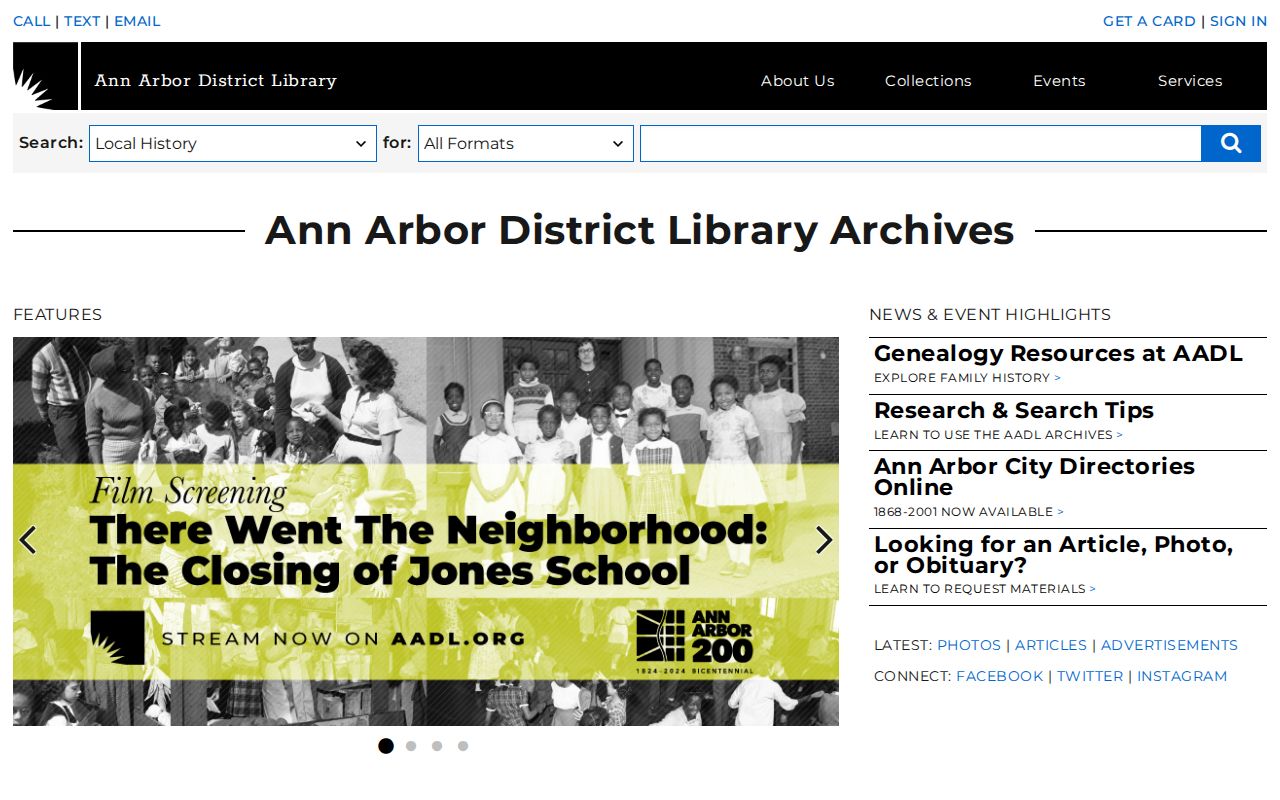
The archive also provides access to local newspaper and genealogy material that can corroborate an entry.
Washtenaw City Directory Years and Publishers
Publisher and coverage changes shape the result. The 1883-84 Washtenaw County Directory and the 1886-87 Ann Arbor City and Washtenaw County Directory reach beyond an Ann Arbor-only search. The 1888-89 Polk volume includes Ann Arbor, Ypsilanti, and Washtenaw County. Polk editions from 1929 through 1979 provide a long, though not perfect, continuity; the research inventory notes every year from 1960 through 1979. A 1928 Derees & Bennett rural-route directory is especially useful for township and postal-era research.
| Milestone | Directory implication |
|---|---|
| 1868 | Earliest listed AADL Ann Arbor directory, Chapin’s. |
| 1880s | County and city/county volumes broaden coverage. |
| Late 1960s onward | Bresser-style criss-cross volumes become a common reverse-directory format. |
| 2000-01 | Latest listed Ann Arbor directory run. |
Reading a Washtenaw City Directory Entry
A surname entry can supply more than a name. The Library of Michigan describes common fields such as occupation, other household members, a street address, and owner/renter notation. Street sections reverse the view by arranging entries by street and house number. Phone sections are generally heads-only. Later Bresser or criss-cross volumes can add telephone, first-listed year, new-arrival, and relocation clues. Read the volume’s abbreviation key before interpreting a single letter or parenthetical name.
| Name | Household head and, in some surname entries, relatives or spouse. |
|---|---|
| Occupation | A dated work or community description, sometimes with an employer. |
| Address | Street and number for that edition, which may need historical translation. |
| Owner/renter mark | A notation that must be read against the volume’s key. |
| Reverse section | Street and number order, useful for a block or address question. |
- Criss-cross directory
- A reverse directory arranged by street and house number.
- Householder index
- A name-led listing that can point back to an address or household entry.
- Abbreviation key
- The volume’s explanation of condensed labels; preserve it before drawing conclusions.
Washtenaw City Directory Sample Evidence
AADL’s item-level directory browse route makes it possible to locate a dated volume before reading the name and street sections. A sample result should be transcribed with the exact printed surname, initials, address, occupation, owner/renter notation, edition year, and page or item detail. The research did not verify a live scan field by field, so a directory notation should be read from the actual selected volume, not guessed from a different publisher’s format.
The AADL directory browse route is shown below. It is a visual reminder to retain the publication identity with the entry.
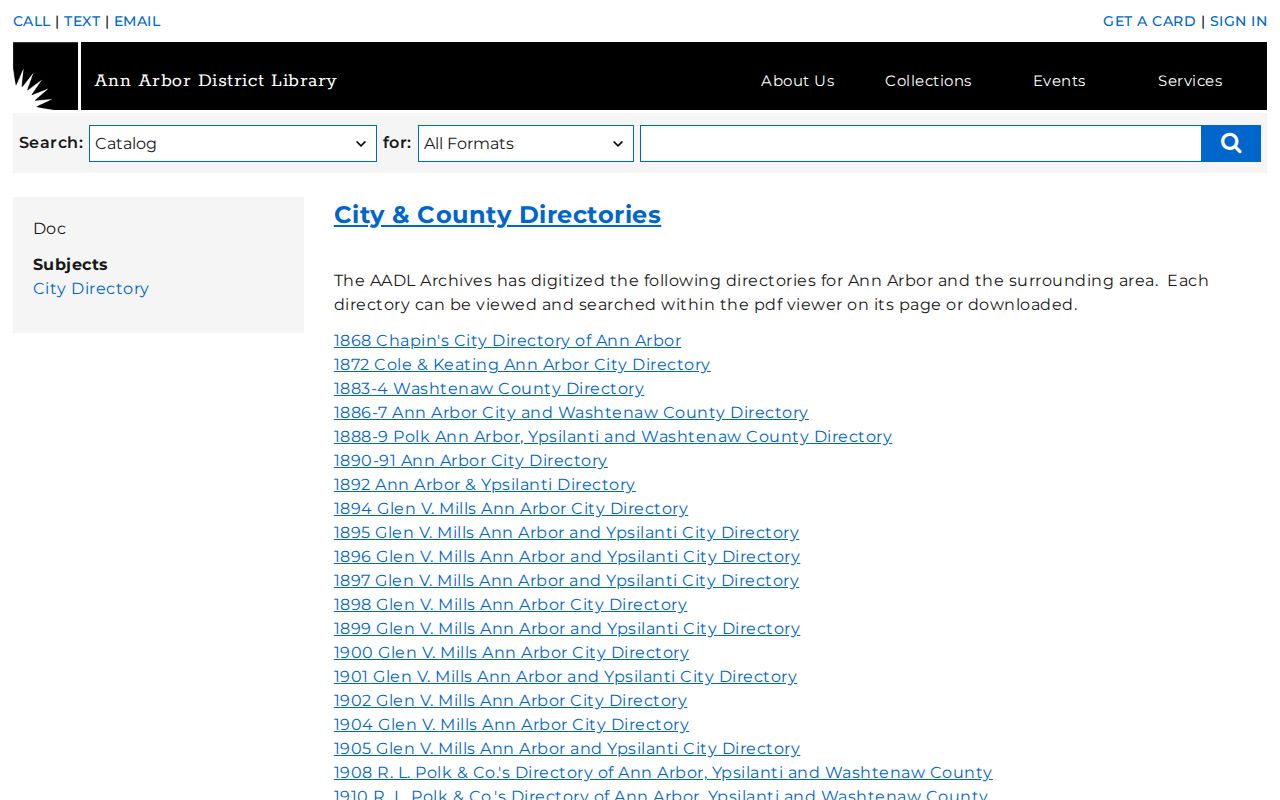
That citation makes later comparison with a census, deed, or newspaper article reproducible.
Washtenaw Directories Between Census Years
A directory can bridge the long interval between census releases. Start with a surname or street hit in one edition, then check nearby editions for a move, changed occupation, widow notation, or disappearance. Pair the directory year with federal Washtenaw census microfilm from 1830 through 1930, and use the state-census years listed in the Library of Michigan guide where appropriate. Newspaper searching can explain a move, death, business change, or local event that a bare directory line cannot explain.
The Library of Michigan’s Washtenaw guide also lists Ann Arbor News, Chelsea Standard, Dexter Leader, Manchester Enterprise, and Ypsilanti Sentinel runs. These are companion sources, not a substitute for careful date matching.
Library of Michigan Washtenaw Guide
The Library of Michigan’s Washtenaw County guide identifies a 1886 directory, selected Washtenaw directory runs from 1965/66 through 1993/94, census resources, cemetery inscriptions, land atlases, and local newspaper holdings. Its city-directory guidance also explains surname, street, telephone, classified, and criss-cross sections. The physical collections are a useful fallback when the AADL digitized run does not include the needed edition.
The Library of Michigan guide is shown below. Use its item and series listings to plan a library or archive request.
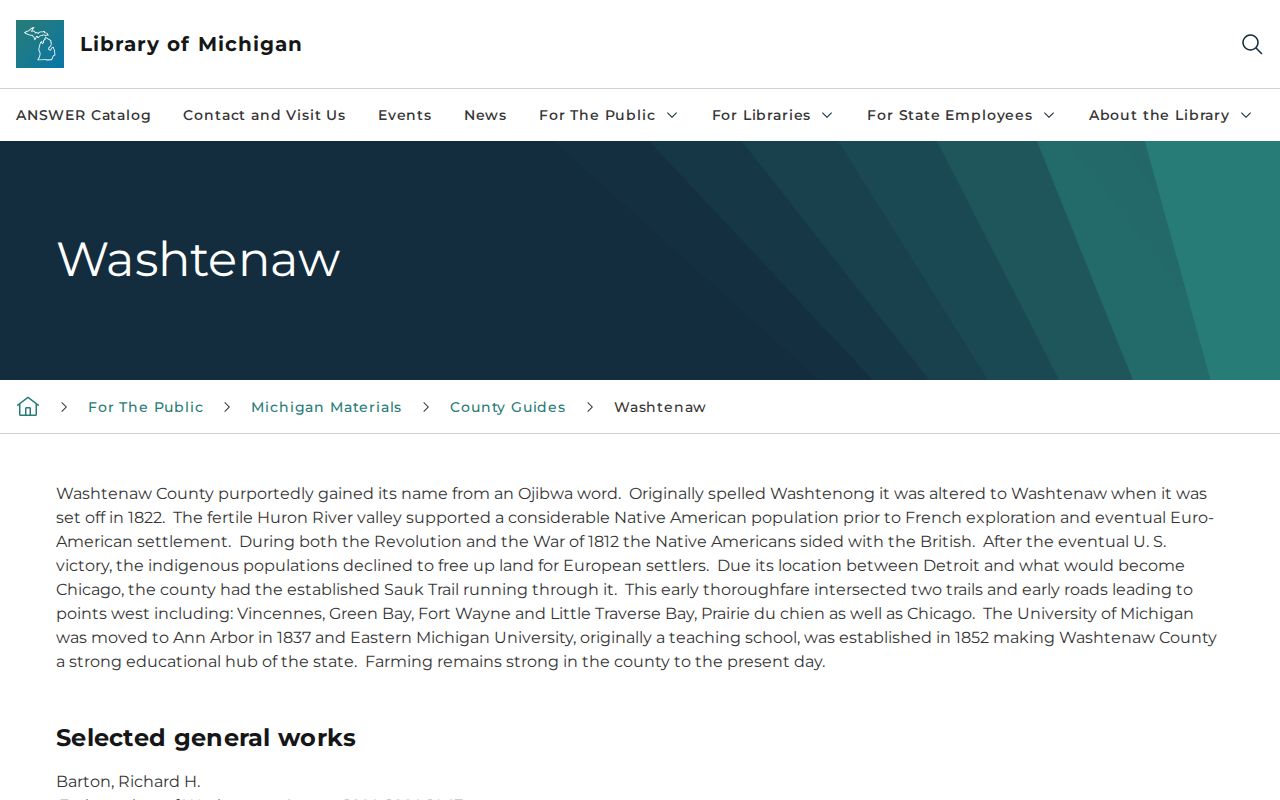
The guide broadens a city-directory search into the county’s newspaper, atlas, census, cemetery, and vital-record research paths.
Tracing Families in Washtenaw City Directories
Family-history work becomes stronger when it moves forward and backward through specific editions instead of jumping from one isolated name hit to another. A householder may move, be omitted, appear under an initial, or use a historical street name. The record should remain a dated observation until independent evidence lines up. When an address question becomes modern property work, the Washtenaw street directory uses parcel and deed records rather than rebuilding the historical shelf.
- Locate the first verified edition and save its year and item reference.
- Follow the surname through nearby years, keeping initials and variants separate.
- Use the street or criss-cross section to test the address in that same edition.
- Pair directory years with census microfilm, newspapers, maps, and a dated deed or parcel record.
- Use AADL’s Ann Arbor News archive, local history staff, or an archive guide when the directory trail ends.
A disappearance can mean a move, death, changed name, unlisted household, or a gap in publication. It is a prompt for the next source, not a conclusion by itself.
For the years before regular city-directory coverage, Washtenaw research can use land records from 1827, state-census entries for 1827, 1834, 1845, 1850, and 1870, early marriage material, tax rolls, and archival court or naturalization series. For later years, AADL’s Ann Arbor News archive, local periodicals, yearbooks, and historic maps provide useful confirmation. The Archive of Michigan Washtenaw guide and Bentley finding aids are the appropriate fallback when a digitized volume or online index is silent.
Keep a gap ledger. It should note the exact years checked, the collection used, whether the source was online or staff-assisted, and what result was absent. That is more useful than assuming a person moved merely because a name is missing from a single city directory edition.