
Washtenaw Previous Residents by Era
The best source depends on the period. Washtenaw land records are documented from 1827, though the exact online-index cutoff is not in the official research. AADL’s directories extend from 1868 to 2001 with gaps, Sanborn maps cover 1888 to 1948, and Washtenaw census microfilm runs from 1830 to 1930. Earlier work may need deed books, archive guides, abstracts, plats, and court or probate series. Later work should begin with current parcel and Register records, then move backward only when the legal description stays consistent.
| Source | Years It Covers | Where Held | What It Shows |
|---|---|---|---|
| Land records and deed index | County records documented from 1827 | Clerk/Register and older archive routes | Recorded party, instrument, legal-description, and transfer trail |
| AADL city directories | 1868-2001 with gaps | AADL online, print, and staff help | Dated household, address, occupation, and street clues |
| Sanborn maps | 1888-1948 | AADL microfilm | Building footprint, street geometry, and edition context |
| Washtenaw census microfilm | 1830-1930 | AADL and archive guides | Household and locality context by census year |
| Probate, newspaper, and survey material | Varies by series | Courts, AADL, Archives, historic surveys | Estate, obituary, community, and house-history clues |
Start with the current parcel and deed trail for recent transfers. Begin with directories, census, newspapers, and maps when the question is a historic household rather than ownership.
Washtenaw Parcel Clues for Past Residents
The County Property/Parcel Lookup provides the starting identity for a house history: the PIN, city/village/township, property address, taxpayer name and mailing address, legal description, and sales-history fields including Liber/Page, sale date, and instrument. Preserve the situs and taxpayer mailing address separately. A homestead or PRE percentage may support a dated owner-occupancy hypothesis, but it does not prove who lived at a house. The legal description and PIN are more durable than a street number when a name or numbering pattern changes.
Tracing the Washtenaw Deed Chain
To trace previous residents who owned a property, use the parcel report as a lead into the Register of Deeds public index. Search the current buyer or grantee, confirm the party spelling and instrument, then use the seller or grantor to find the earlier link. Stop when the lot, subdivision, PIN, or legal description stops matching. An index line is not the instrument itself. The current portal’s exact historic cutoff is unverified, so older work may continue through deed books, abstracts, plats, Archives of Michigan material, or the Bentley Washtenaw Abstract Company finding aid.
- Capture the present PIN, municipality, legal description, and sales-history Liber/Page.
- Search the recorded index for the current buyer or grantee using spelling variants.
- Confirm document type, recording reference, page count, and legal-description continuity.
- Search the seller or grantor as the earlier buyer or grantee and repeat.
- Use archive, abstract, deed-book, plat, or survey routes when the web index ends.
- Grantor and grantee
- The party transferring property and the party receiving it in a recorded transaction.
- Chain of title
- The sequence of recorded transfers linked by matching land identity.
- Legal description
- The land description used in records, often more stable than a street address.
Washtenaw Previous Residents and Sanborn Maps
AADL’s Sanborn Fire Insurance Maps cover 1888 through 1948 on microfilm. For a past address, first identify the directory, deed, tax, or newspaper date. Next locate the corresponding Sanborn edition and sheet, record both, and compare the building footprint and street geometry with the legal description and later parcel record. A Sanborn map is strong physical context but is not title proof. The City of Ann Arbor’s historic surveys and reports add another house-history route for qualifying local context.
Ann Arbor’s historic-survey route is shown below. Use a survey as a source of dated context, then verify names and ownership independently.
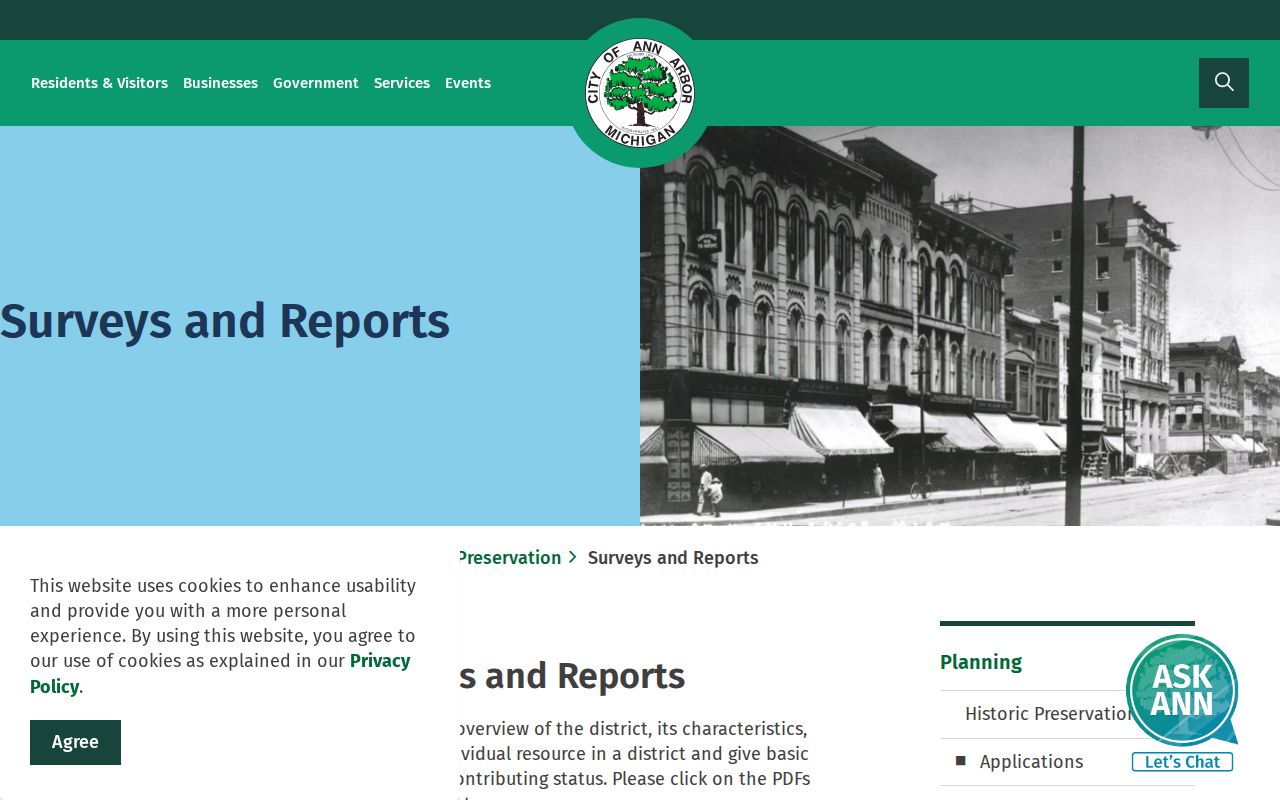
Combining a map edition, directory year, and parcel identity helps avoid a false address match.
Washtenaw Addresses With Former Names
Ann Arbor’s old street grid makes historic address matching unusually sensitive. AADL documents First through Fifth Streets on John Allen’s 1824 plat, Main’s Third Street alternate, mirrored Old West Side numbering, and the 1891 change in which Seventh absorbed Jewett and Mann. When an old directory line seems to name a different house, make a translation table with the edition, printed name, number and direction, modern cross-street, PIN, and supporting map or plat. Label a bridge as an inference until the records align.
AADL’s Lost Street Names research is pictured below. It helps explain why a bare number cannot carry a house-history conclusion by itself.
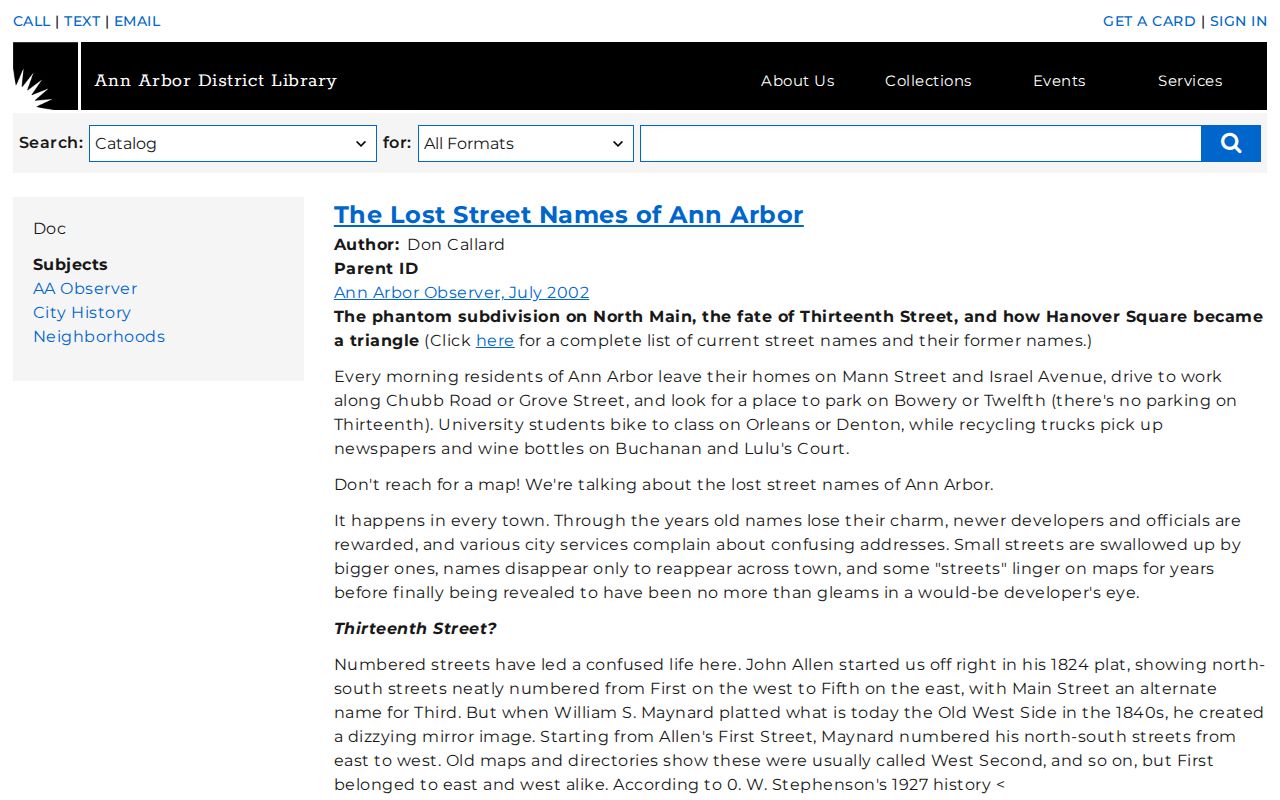
Use a legal description or PIN to hold the property identity steady while names and numbers shift.
Washtenaw Deed Index for Address History
The Washtenaw Register of Deeds public index supplies the recorded-document trail behind a parcel. Search party names with spelling variants and preserve the exact index labels for document type, recording date, Liber/Page, page count, and any visible reference. The index is not the deed image. Confirm the reference before using the office’s purchase, mail-copy, or certification route, and do not infer a prior household from a seller or buyer name without supporting evidence.
The public deed-index portal is shown below. It is the route from a parcel’s sales-history clue to a dated recorded instrument.
For earlier land work, the online cutoff remains unverified, so the archive and abstract fallback remains essential.
Washtenaw Directories and Census Pairing
Owners are only part of a prior-resident trail. AADL’s city directories can show a household at an address in specific years, while Washtenaw federal census microfilm from 1830 to 1930 provides a broader household snapshot. Search the address or surname in nearby directory editions, then compare the closest census, newspaper item, or obituary. For the collections, publisher runs, and entry reading, use the Washtenaw city directories section rather than treating every source as a duplicate list.
Directory disappearance may mean a move, death, name change, unlisted household, or a gap in the run. Probate and obituary research can help close a trail, but a named heir should not be presumed to live at a particular address.
Washtenaw Previous Residents and Households
Previous residents research is well suited to house history, family history, estate questions, and personal curiosity when each historical role is accurately described. A current taxpayer, past owner, dated directory occupant, and obituary subject may be different people. Never convert a record of ownership or a historical address mention into a claim about a living person’s current location. Keep source date, access route, and uncertainty alongside the result.
For a record not available online, use the responsible office, AADL staff-assisted research, the Library of Michigan, Archives of Michigan, or the court’s public-file route. Older sources often require the counter, microfilm, or a finding aid rather than a portal search.
The local record chronology helps select that fallback. Archives of Michigan identifies Washtenaw chancery indexes from 1827 to 1876, court calendars and case files in the nineteenth century, naturalization series from the 1830s forward, probate calendars and estate files, tax rolls, voter registers, school records, and vital indexes. AADL adds directories, newspapers, census microfilm, and maps. Use the time period to choose the shelf before assuming the address has no surviving trail.
Record each negative search as well as each hit. It prevents a missing digital result from being mistaken for a missing historical record.
Lawful use. Use Washtenaw previous-resident information for lawful house and family history. Do not track, harass, intimidate, or harm any living person.